
Screens and doors
Fireplace screen or glass doors: which one your hearth needs
A screen and a set of glass doors both stand between your room and the fire, yet they do different work. One keeps sparks on the hearth while the logs burn, the other gives a masonry opening a finished face, and plenty of homes end up with both.
Pleasant Hearth guides · September 26, 2026
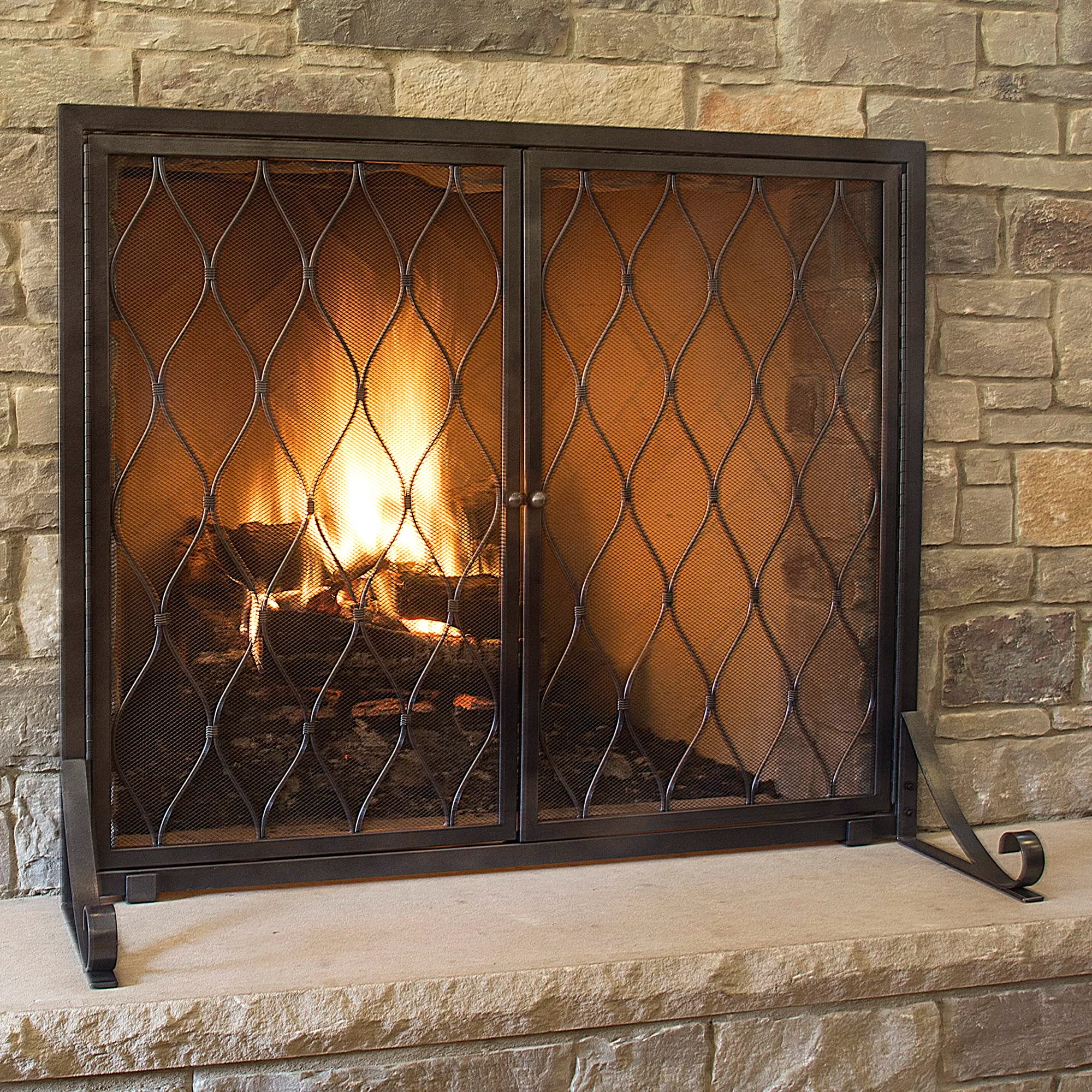
What a fireplace screen does
A fireplace screen has one job while the logs burn: it keeps embers and sparks on the hearth and off your floor. USFA, the U.S. Fire Administration, asks for a glass or metal screen in front of the fireplace for that reason. NFPA, the National Fire Protection Association, puts a sturdy screen against sparks on its short list of heating rules.
Most screens stand on the hearth instead of fixing to the brick, so you lift one aside to add a log and set it back when you are done. Our Victorian Gothic screen spreads three arched panels across 48 by 30 inches. The Mission Style is wider, with three panels over 54 by 31.5 inches. At 48 by 30 the Iris Scroll matches the Victorian Gothic, and the Sheffield runs 54 inches long in a vintage iron finish. Measure your fireplace opening before you pick one, because a panel screen stops sparks only across the width it covers.
Glass counts as well as metal in the USFA advice. Our freestanding glass screen is a single panel, 38 inches long and 27.5 inches tall, that sits flush against the fireplace on adjustable back feet. It suits a smaller opening where you want to see the whole fire without mesh in the way.
A screen does not shrink the three-foot rule. NFPA and USFA both ask for at least three feet between a fireplace and anything that can burn, and NFPA adds a three-foot zone around open fires where children do not play. The screen stands inside that zone. Your armchair, the kindling basket and the stack of magazines stay outside it.
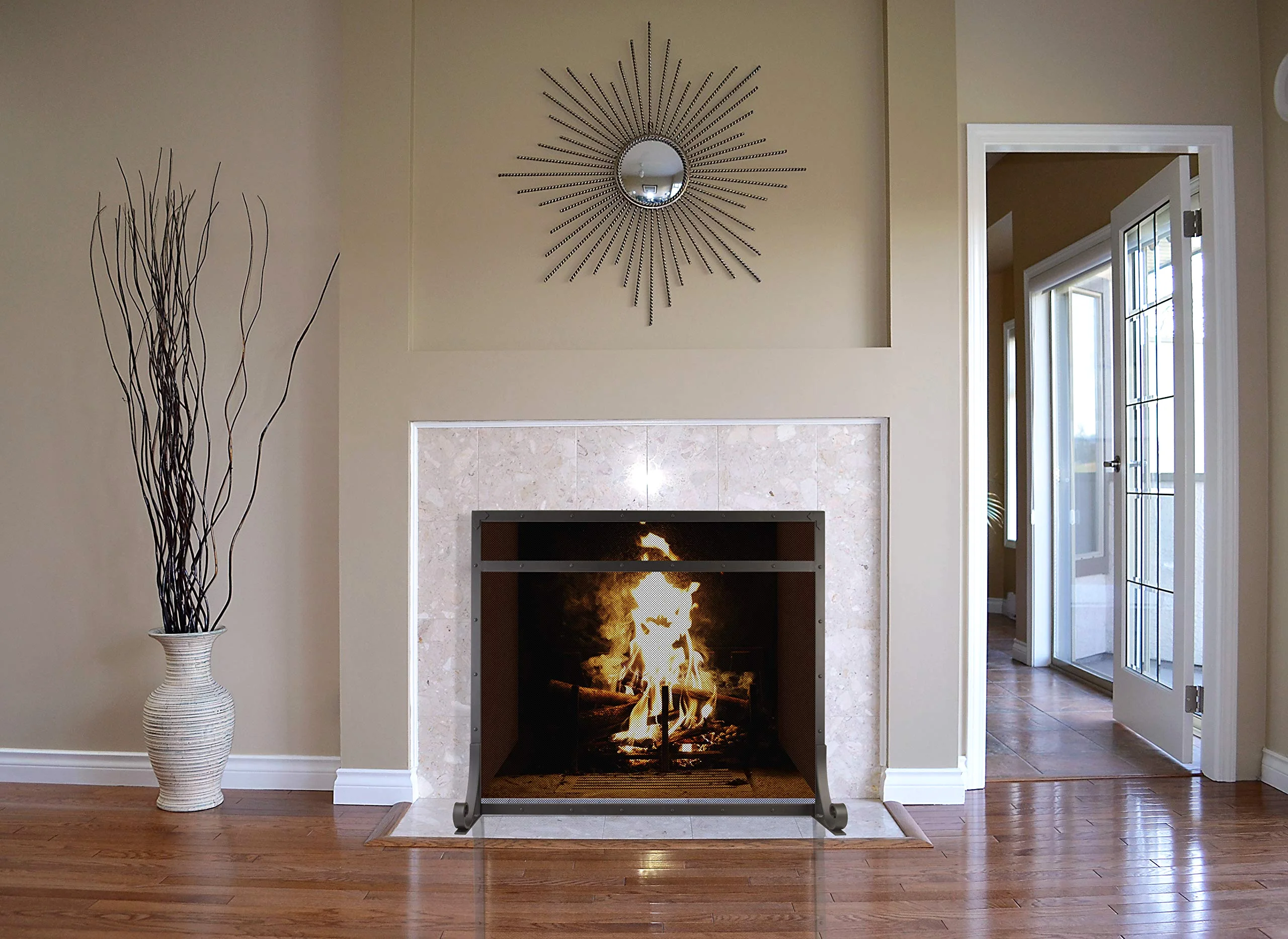
Screens with doors
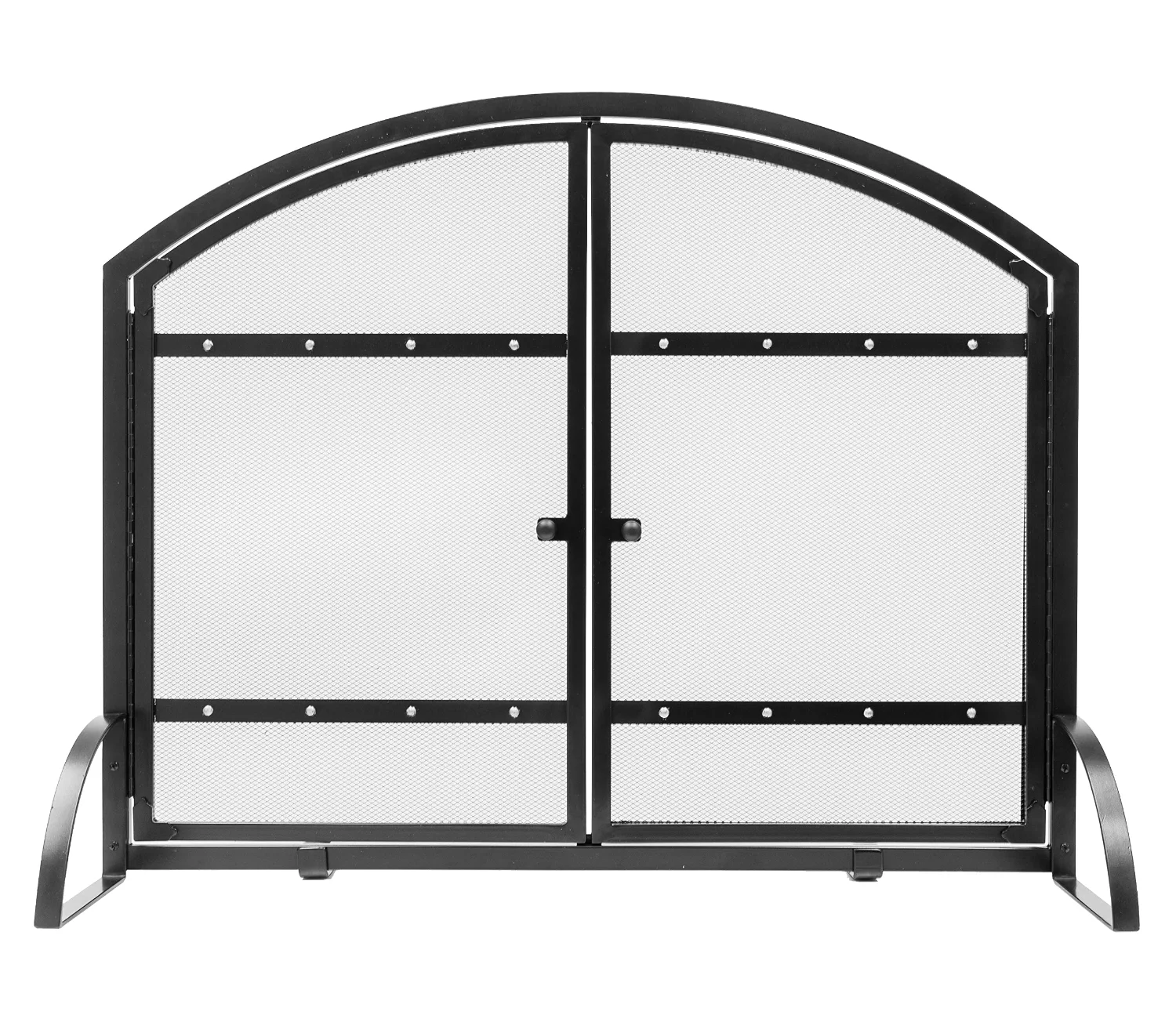
A panel screen has to move every time you tend the fire. Our Stonewall and Manchester screens stay put instead: each sits flush against the fireplace on adjustable back feet, with two doors set into a single panel. Open the doors, turn a log with the poker and close them again.
The Harper works the same way inside an arched frame 39 inches long and 31 inches tall. Debden holds its two doors shut with easy-catch magnets. The Manchester comes in a petite size for smaller openings as well as a large one, with a patterned glass border around the mesh. All of them sit together among our fireplace screens with doors.
This style suits a home where the fire gets lit often and tended all evening. Nobody has to carry a wide screen away from a live fire, and the panel never leaves its place on the hearth while you work.
Finish decides the rest. The Stonewall comes in gunmetal, the Harper in antique black and the Debden in powder-coated black, so the screen can match the tool set or the grate you already own.
What glass doors do
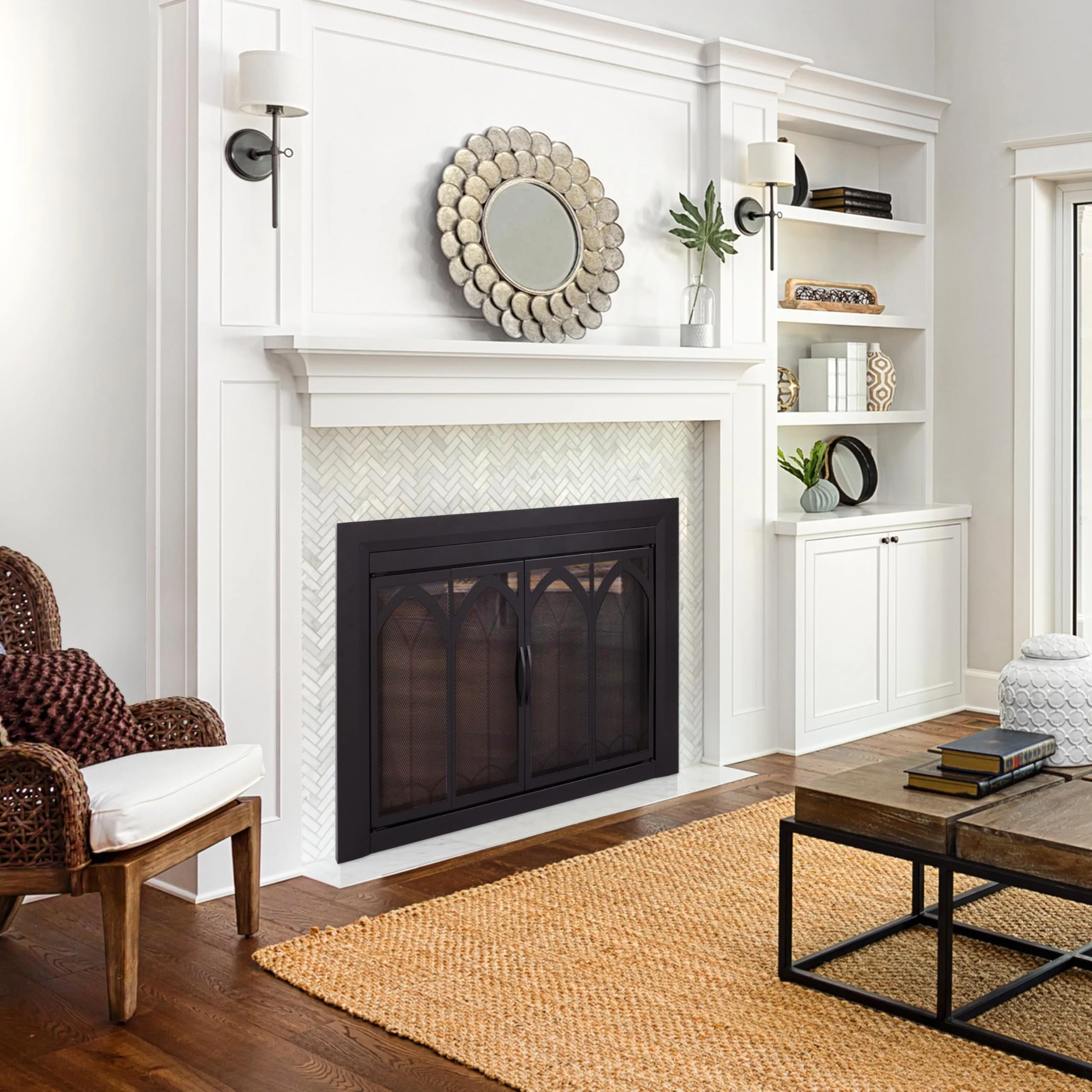
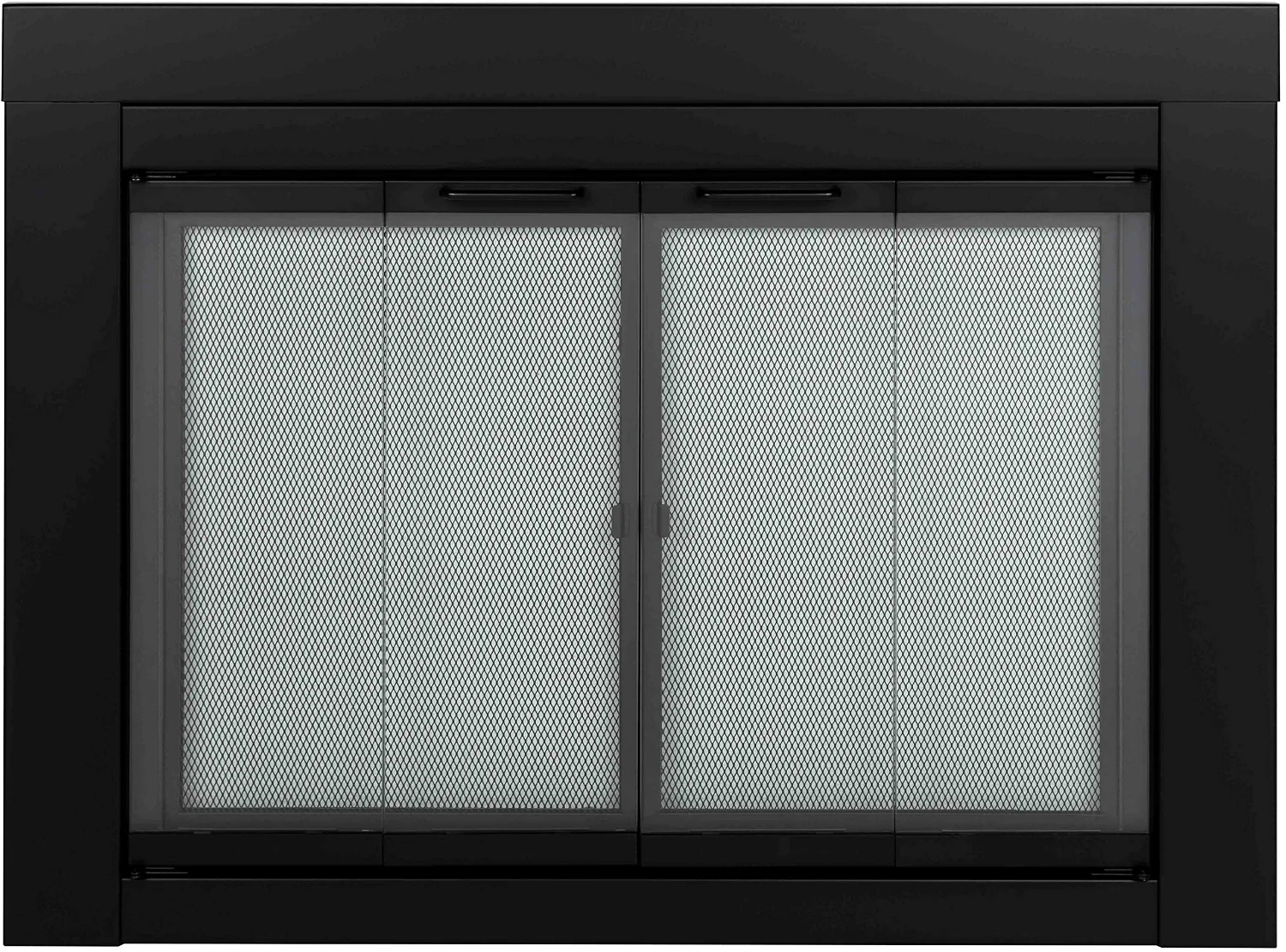
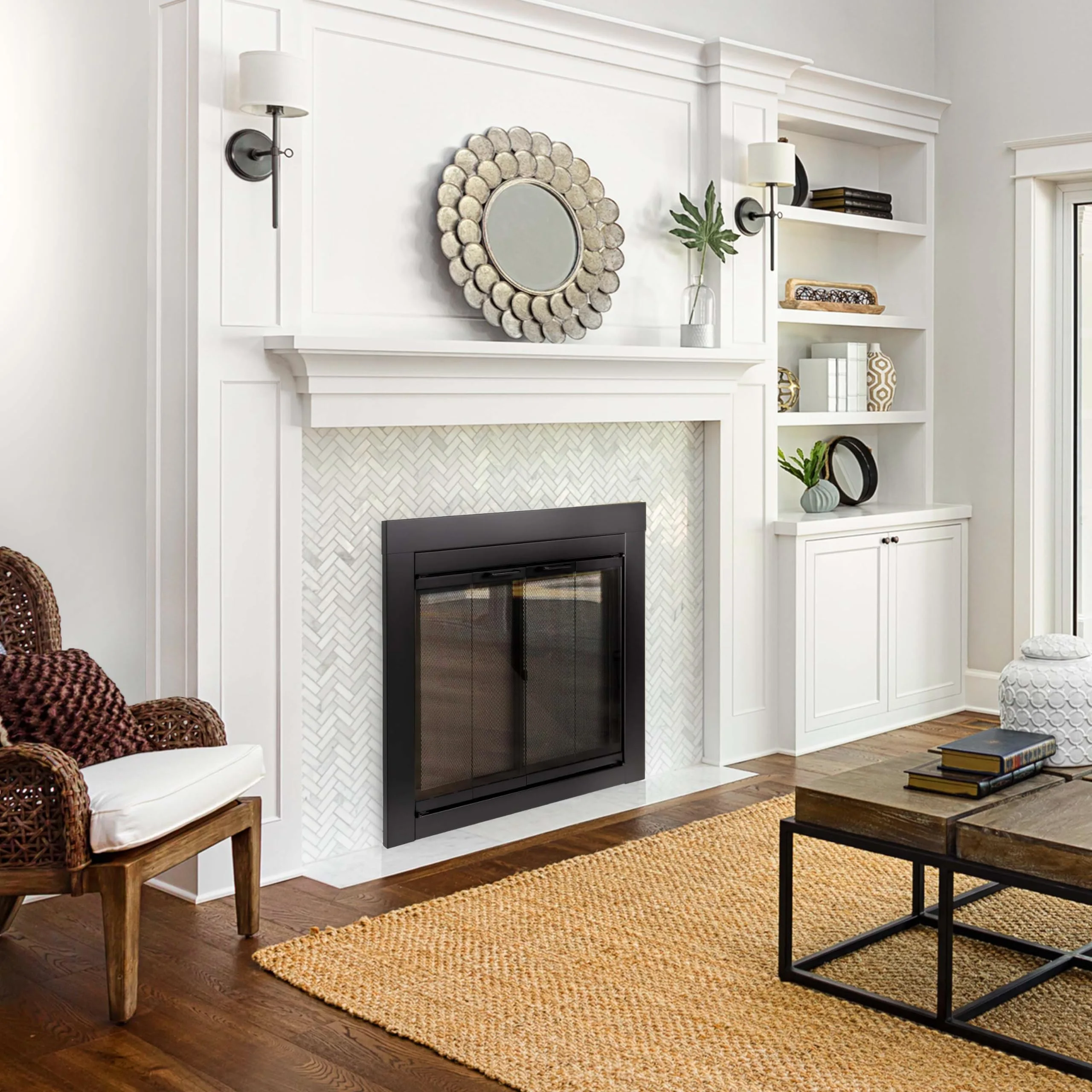
Glass doors are a different object altogether. They mount on the face of the fireplace, outside the opening, and turn it into a finished front: a frame in the finish you pick, tempered glass, and mesh panels behind the glass. Every glass door in the the Pleasant Hearth collection catalog is built for a masonry, wood-burning fireplace. None of them fits a prefabricated (factory-built) fireplace or a metal firebox.
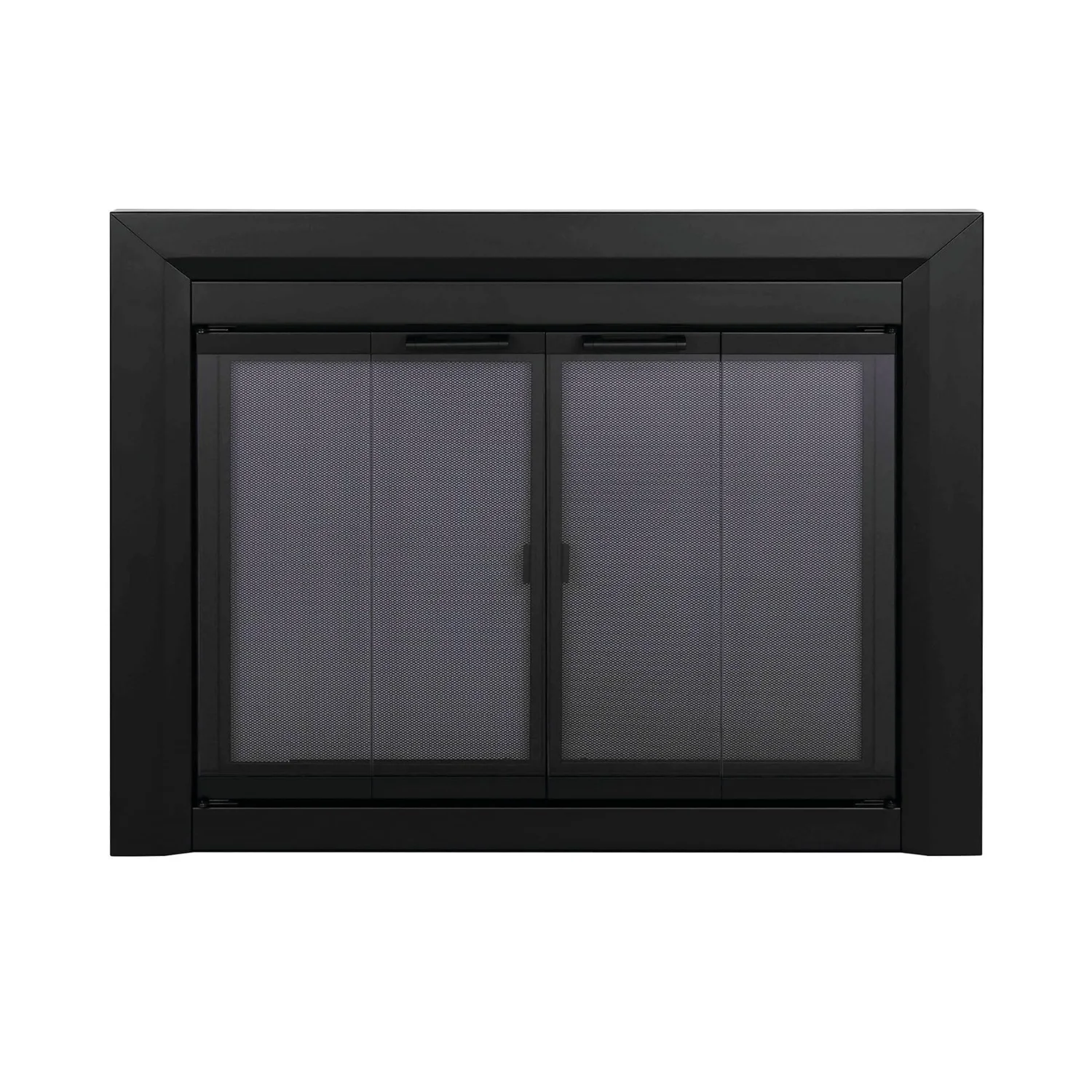
Within that rule the choices are practical ones. Bi-fold doors, such as the Ascot and Clairmont, fold back in pairs toward the sides of the frame. Cabinet doors, such as the Carlisle and Fenwick, swing open like a cupboard. The glass is 3/16-inch tempered, clear on the Ascot and smoked on the Carlisle, Clairmont and Fenwick. Frames run from black and gunmetal to oil rubbed bronze, heritage brass and skyline nickel.
Shape and material vary too. The Gavin sets its bi-fold glass in a three-sided bay, so the doors stand forward of the wall like a small bay window. Our Linear Aluminum uses an extruded aluminum frame, while the Albus, Amhearst and Axel pair a hammered black finish with cabinet doors and smoked glass.
Many of our doors add an air control as well: a slide on the Ascot, a hidden damper knob on the Fenwick and Alsip. With it you set how much air reaches the fire through the frame. On a night with no fire planned, close the glass, and the firebox, soot and all, drops out of sight.
Glass open, mesh closed while the fire burns
Here the two jobs split. While a fire burns behind glass doors, the glass stays open and the mesh panels stay closed. We print that instruction with our Alsip and Fenwick doors, and the reason lies up in the chimney.
Wood smoke leaves a residue called creosote inside a cooler chimney. CSIA, the institute that certifies chimney sweeps, calls it highly combustible and says it builds up faster when the fire is short of air. Closing the glass doors is one of the ways CSIA names for restricting that air, next to a damper that is not opened wide enough and too little make-up air in the room. EPA gives a matching list of causes: restricted air, unseasoned wood, a cold chimney and an overloaded firebox.
So the mesh handles the sparks, and the glass stays open until the fire is out. A wood stove works differently, and USFA says to keep a stove's doors closed except while you load or stoke it. Your masonry fireplace is not a stove, and CSIA's warning about closed glass doors applies to it.
How screens and doors combine
Plenty of hearths end up with both, and the pairing takes three forms. Glass doors with mesh panels already hold a screen and a door in one frame. A panel screen in front of a fireplace without doors covers the open fire by itself. Between the two sits the screen with doors, freestanding like a screen and opened like a door.
Because the mesh does the screen's work on a set of doors, compare it as closely as you compare the glass. The Ascot comes with standard mesh, the Carlisle and Clairmont with fine mesh, and the Fenwick, Alsip and Gavin with rigid mesh panels. Both the glass and the mesh on the Fenwick close with easy-catch magnets.
Tools belong to the pairing too. The Victorian Gothic screen coordinates with our arched four-piece tool set. Pair the Mission Style screen with the five-piece Mission set, and the poker on its stand matches the frame in front of the fire. Our screen and tool set combinations gather the matched pairs in one place.
Which one fits your fireplace
Start with the fireplace you have, then think about how often you light it.
- Factory-built fireplace or metal firebox. Our glass doors are not made for it, so a freestanding screen is the answer. The Selene, 39 inches long, sits flush against the fireplace on adjustable back feet.
- Masonry fireplace, lit most evenings. Either a screen with doors or glass doors with mesh panels lets you reach the logs without lifting anything off the hearth.
- Masonry fireplace, cold for months. Glass doors give the opening a finished face through the seasons you do not use it. On the nights you do, open the glass and draw the mesh.
- Opening wider than a door size. The Large Ascot, Carlisle and Clairmont take openings 36 to 43 inches wide. For a wider mouth, a three-panel screen such as the 54-inch Mission Style spans more.
- A view of the fire from across the room. Clear glass on the Ascot or Fillmore shows the flames as they are. Smoked glass on the Carlisle or Clairmont tones the view down and keeps a cold firebox darker behind the frame.
- Small children at home. Either choice keeps sparks on the hearth. Neither one replaces the three-foot zone NFPA asks for around an open fire.
Measuring for glass doors
Measure the front opening, width and height, to the nearest 1/8 inch, as our Clairmont instructions ask. Then set your numbers against the range printed for each door. Small and Medium doors both fit openings 30 to 37 inches wide. Height is where they part: the Small Ascot takes 22.5 to 29.5 inches, the Small Carlisle and Clairmont 22.5 to 27.5, and the Medium sizes 25.5 to 32.5.
The Clairmont and Alsip each include a 2-inch riser bar, packed unassembled, for extra frame height. Our Fillmore is a nine-pane cabinet door in the prairie style, with clear tempered glass and rigid mesh panels. Built for masonry fireplaces, it fits openings 30 to 37 by 25.5 to 32.5 inches in Medium. For the full method, open our door sizing guide, then compare the models on our glass doors shelf.
| Model | Type | Size or opening | While the fire burns |
|---|---|---|---|
| Victorian Gothic | Three-panel arched screen | 48 x 30 in. | Stands in front of the opening |
| Mission Style | Three-panel screen | 54 x 31.5 in. | Stands in front of the opening |
| Selene | Single panel on back feet | 39 x 31 in. | Stands flush against the fireplace |
| Stonewall | Single panel with two doors | 38 x 31 in. | Doors closed, opened to tend |
| Harper | Arched screen with doors | 39 x 31 in. | Doors closed, opened to tend |
| Debden | Single panel with two doors, magnet catches | 39 x 31.44 in. | Doors closed, opened to tend |
| Fillmore | Cabinet glass door, clear glass, masonry only | Opening 30 to 37 x 25.5 to 32.5 in. (Medium) | Glass open, mesh closed |
| Ascot | Bi-fold glass door, clear glass, masonry only | Opening 30 to 37 x 22.5 to 29.5 in. (Small) | Glass open, mesh closed |
| Carlisle | Cabinet glass door, smoked glass, masonry only | Opening 30 to 37 x 22.5 to 27.5 in. (Small) | Glass open, mesh closed |
| Clairmont | Bi-fold glass door, smoked glass, masonry only | Opening 36 to 43 x 25.5 to 32.5 in. (Large) | Glass open, mesh closed |
What neither one does
A screen and a set of glass doors change what reaches your room from the firebox. What builds up in the flue is a separate matter. NFPA, USFA and CSIA all call for a yearly chimney inspection by a professional, with cleaning when it is needed.
Nor does either one make it fine to leave a fire alone. USFA asks you to put the fire out before you go to sleep or leave home, whatever stands in front of it.
Glass doors do not move the three-foot line either. With the glass open, the fire behind the mesh is an open fire, and NFPA's zone around it stands as before.
When the fire is out, the ashes can still hold heat. NFPA says to let them cool before they go into a metal container, and USFA puts that lidded container outside, at least 10 feet from the house.
At Pleasant Hearth we cover the front of the fireplace: screens, doors, tools and grates. Keeping up the chimney and the ash can outside is your part of the job.
From the catalog
Pieces from this guide
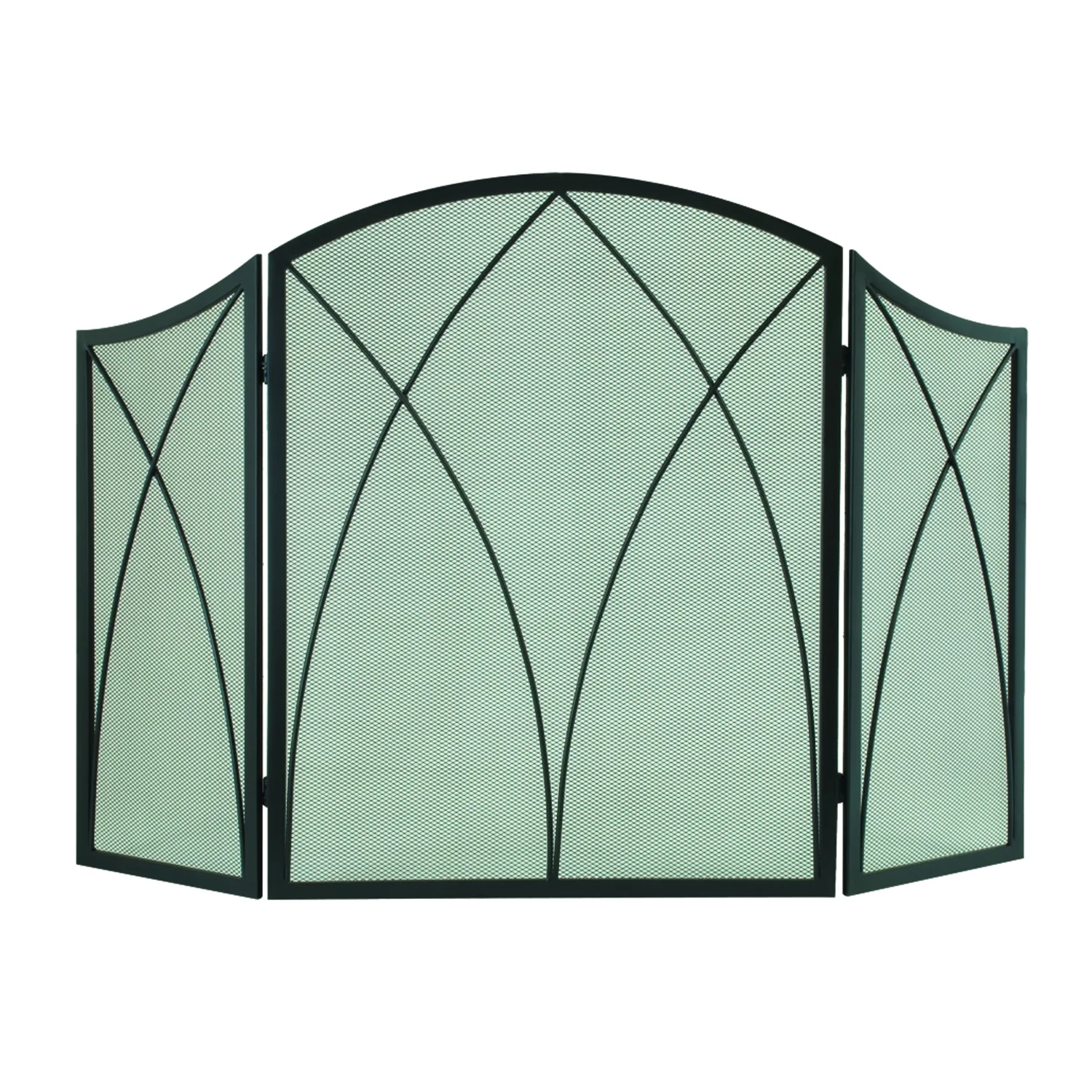

Pleasant Hearth Victorian Gothic arched 3-panel fireplace screen
48 x 30 in


Pleasant Hearth Ascot fireplace glass door
Small, Medium, Large · Bi-fold · clear glass

Pleasant Hearth Clairmont fireplace glass door
Small, Medium, Large · Bi-fold · smoked glass
